Design Patterns A quick guide to Abstract Factory by Andreas Poyias
Table Of Content
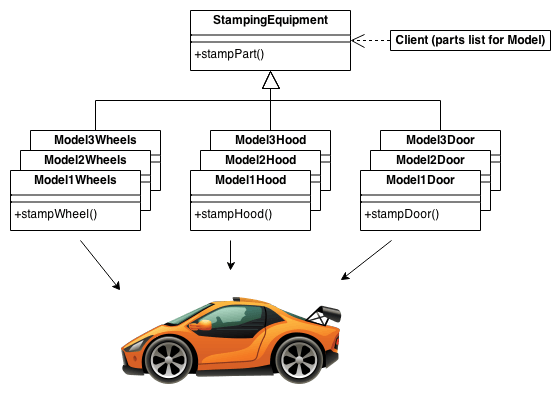
But now you need to tell the main UIFramework class to use the new button subclass instead of a default one. As a result, you will end up with pretty nasty code, riddled with conditionals that switch the app’s behavior depending on the class of transportation objects. Imagine that you’re creating a logistics management application. The first version of your app can only handle transportation by trucks, so the bulk of your code lives inside the Truck class. Then we have the abstraction and implementations for the kingdom factory. The elven kingdom needs an elven king, elven castle, and elven army whereas the orcish kingdom needs an orcish king, orcish castle, and orcish army.
Creational Design Patterns
Instead, it is a description or template for how to solve a problem that can be used in many different situations. Use the FactoryProducer to get AbstractFactory in order to get factories of concrete classes by passing an information such as type. In Abstract Factory pattern an interface is responsible for creating a factory of related objects without explicitly specifying their classes. Each generated factory can give the objects as per the Factory pattern. Create your own design, or use the guidance and expertise of our skilled design department to create one for you.
I thought factory methods only create one product?
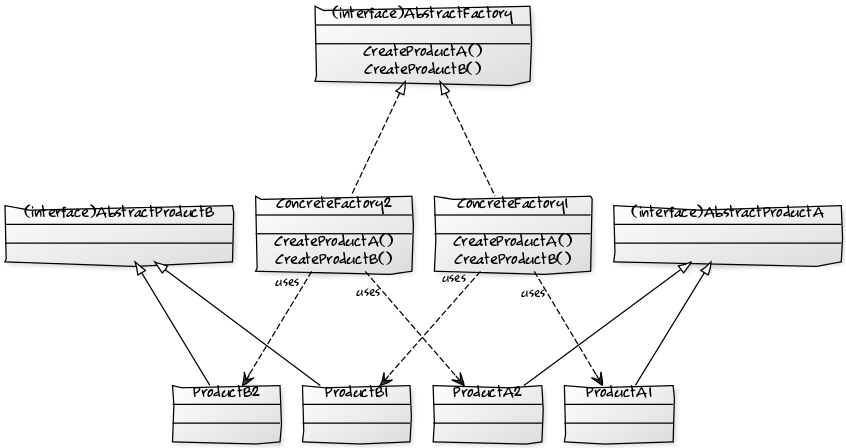
And you want some module to create instances and use them, without knowing any details of object initialization.For example - you want to create Java objects doing some calculations. But some of them are part of the application, while other's bytecode should be read from the DB. But in some cases - it is much less code to write, having less classes and interfaces makes system easier to comprehend. In the above examples, we wrote the SicilianPizzaFactory and GourmetPizzaFactory subclasses of the abstract BasePizzaFactory class.
Factory Design Pattern in Unity - Meet Janiyani's Blog - GameDev.net
Factory Design Pattern in Unity - Meet Janiyani's Blog.
Posted: Wed, 21 Feb 2024 08:00:00 GMT [source]
Abstract Factory Design Pattern in Java
Through this article, I have listed what a Factory Design Pattern is and how to implement a Factory. I hope to receive contributions from everyone so that the programming community can continue to develop, and especially so that future articles can be better. The confusion here is that people conflate composition with dependency injection. Contrast with the IS-A relationship, Client and AbstractFactory have no inheritance between them.
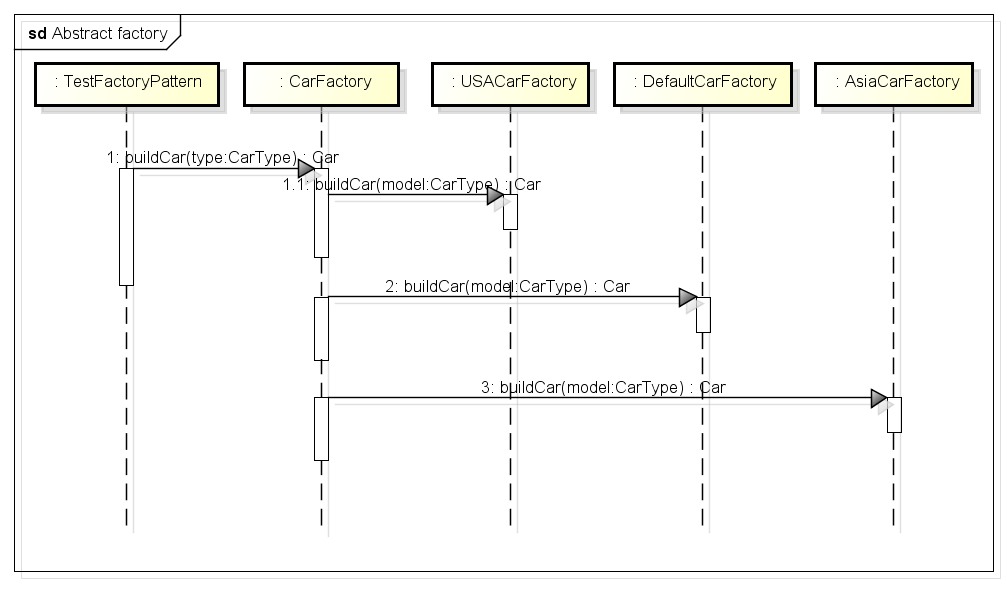
Abstract Products
Actually, this is an example of Factory Method implementations. This C++11 implementation is based on the pre C++98 implementation in the book. Consider implementing the Abstract Factory when you have a class with a set of Factory Methods that blur its primary responsibility.
Families of cross-platform GUI components and their production
While you (as a framework developer) remain at a very abstract level, each builders of the tool is forced to follow your framework-constructs. However, they (the tool builders) have the freedom to decide what object to be built and how all the objects they create will interact. Unlike the previous case (of Abstract Factory Pattern), you (as framework creator) don’t need to work with concrete objects in this case; and rather can stay at the contract level of the objects. Furthermore, unlike the second part of the previous motivations, you or the tool-builders never have the situations of mixing objects from variants. Here, while framework code remains at contract level, every tool-builder is restricted (by the nature of the case itself) to using their own objects.
Additionally, I have used terminology from the book in class and method names. Therefore we introduce the factory method so that the creation of the response class also is abstracted away. What they're saying is that there is an object A, who wants to make a Foo object. Instead of making the Foo object itself (e.g., with a factory method), it's going to get a different object (the abstract factory) to create the Foo object. The Factory Method pattern usesinheritance and relies on a subclassto handle the desired objectinstantiation.
What are the differences between Abstract Factory and Factory design patterns?
We do all of this and more without losing the ability of having our competitive pricing edge. However, this would make the code too dependent on each specific change and hard to switch between them easily. First, we create a BankAccount, which is an abstract class that will contain information commonly used for specific Accounts. If you're completely new to the patterns these examples are propably not the best place to start. Ideally it should return one object per the method client is invoking. Imagine you are constructing a house and you approach a carpenter for a door.
Software Design Pattern in Development
For example, in the future, there might be new types of accounts such as Credit, Debit, etc. At that time, we only need to create additional subclasses that extend BankAccount and add them to the factory method. Use of this pattern enables interchangeable concrete implementations without changing the code that uses them, even at runtime. However, employment of this pattern, as with similar design patterns, may result in unnecessary complexity and extra work in the initial writing of code. Additionally, higher levels of separation and abstraction can result in systems that are more difficult to debug and maintain.
Add a new type of driver-seat or even change something in the engine. Now adding to the complexity, imagine maintaining these problems but for multiple brands. Abstract factory offers a maintainable and clean approach, that can be used for years to come. It would be difficult for a new developer to mess up and so easy to add/remove a new product. A factory of factories; a factory that groups the individual but related/dependent factories together without specifying their concrete classes.
These methods must return abstract product types represented by the previously extracted interfaces, such as Armchair, Sofa, CoffeeTable, and so on. As a result, you don’t need to modify the client code each time you add a new variation of UI elements to your app. You just have to create a new factory class that produces these elements and slightly modify the app’s initialization code so it selects that class when appropriate. The client doesn’t have to be aware of the factory’s class, nor does it matter what kind of chair it gets. Whether it’s a Modern model or a Victorian-style chair, the client must treat all chairs in the same manner, using the abstract Chair interface.
AbstractFactoryPatternDemo, our demo class uses FactoryProducer to get a AbstractFactory object. It will pass information (CIRCLE / RECTANGLE / SQUARE for Shape) to AbstractFactory to get the type of object it needs. Textile Secrets International is the secret source for high-end fashion designers around the world. We have played a leading role in fashion and designer fabrics for the past 18 years. Our continuous evolution has made it possible for T.S.I to be among the few fabric companies to have a full service art studio.
Create Factory classes extending AbstractFactory to generate object of concrete class based on given information. We are fashion forecasters who have a pulse on the marketplace. We spot upcoming trends and products that will be hot next spring, next fall, and even a few seasons after that. Let us guide you into a field of beautiful up-and-coming trends.
Our garment program can help bring your business from conception to completed shipment. We combine the use of our world wide network of fabric factories, Cutters, and Sewing services to produce your complete product. We take all the guess work out of the process so that you can focus on the results. The return types on the create methods are super-types of the products we want to make. The difference is that the intended purpose of the class containing a factory method is not to create objects, while an abstract factory should only be used to create objects.


Comments
Post a Comment